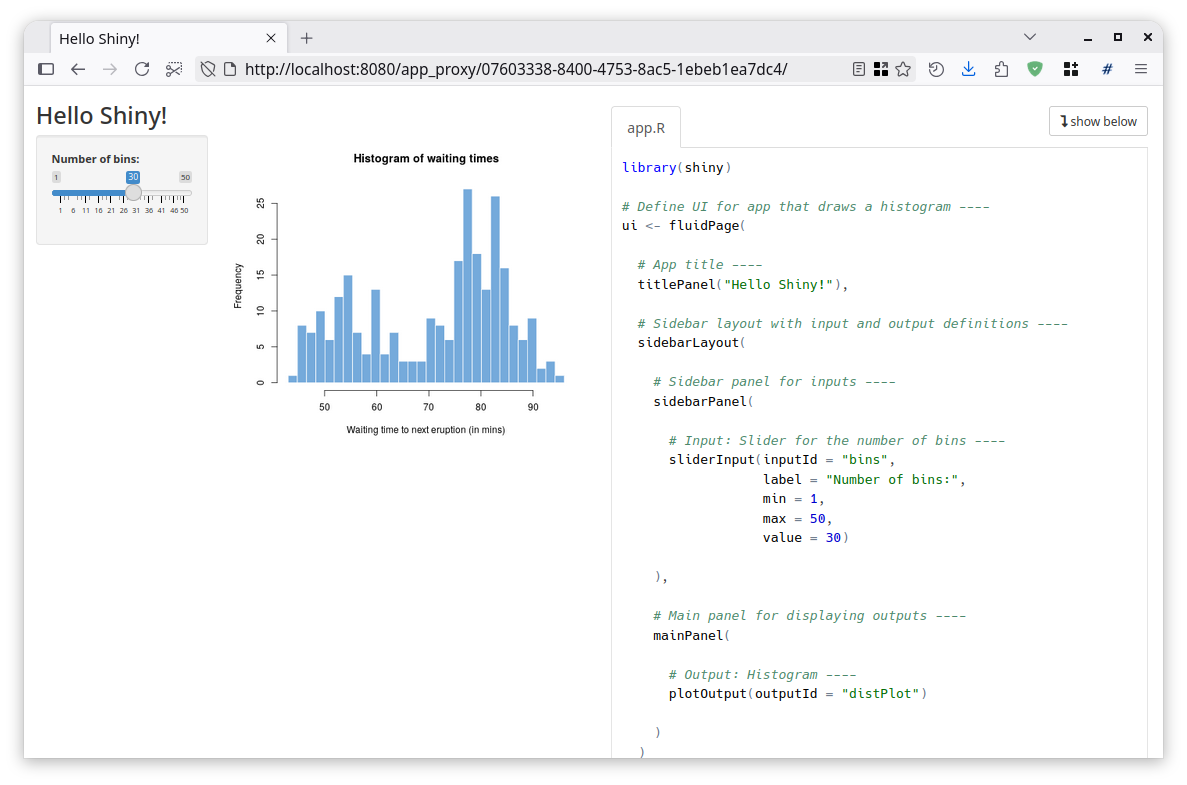
I followed tutorial and setup shinyproxy instance on openstack. My goal was to test shinyloadtest R package - record some tests and rerun them with shinycannon (see webinar). So I run shinyloadtest::record_session(url_to_shinyproxy) and selected example app 06_tabsets from tutorial. Unfortunately I got blank page:
logs:
2018-09-10 16:34:23.017 DEBUG 12069 --- [ XNIO-2 task-10] o.s.b.w.s.f.OrderedRequestContextFilter  : Bound request context to thread: HttpServletRequestImpl [ GET / ]
2018-09-10 16:34:23.026 DEBUG 12069 --- [ XNIO-2 task-10] o.s.b.w.s.f.OrderedRequestContextFilter  : Cleared thread-bound request context: HttpServletRequestImpl [ GET / ]
2018-09-10 16:34:23.523 DEBUG 12069 --- [ XNIO-2 task-11] o.s.b.w.s.f.OrderedRequestContextFilter  : Bound request context to thread: HttpServletRequestImpl [ GET / ]
2018-09-10 16:34:23.535 DEBUG 12069 --- [ XNIO-2 task-11] o.s.b.w.s.f.OrderedRequestContextFilter  : Cleared thread-bound request context: HttpServletRequestImpl [ GET / ]
2018-09-10 16:34:28.335 DEBUG 12069 --- [ XNIO-2 task-12] o.s.b.w.s.f.OrderedRequestContextFilter  : Bound request context to thread: HttpServletRequestImpl [ GET /app/06_tabsets ]
2018-09-10 16:34:28.346 DEBUG 12069 --- [ XNIO-2 task-12] o.s.b.w.s.f.OrderedRequestContextFilter  : Cleared thread-bound request context: HttpServletRequestImpl [ GET /app/06_tabsets ]
2018-09-10 16:34:28.789 DEBUG 12069 --- [ XNIO-2 task-13] o.s.b.w.s.f.OrderedRequestContextFilter  : Bound request context to thread: HttpServletRequestImpl [ GET /app/06_tabsets ]
2018-09-10 16:34:28.795 DEBUG 12069 --- [ XNIO-2 task-13] o.s.b.w.s.f.OrderedRequestContextFilter  : Cleared thread-bound request context: HttpServletRequestImpl [ GET /app/06_tabsets ]
2018-09-10 16:34:41.225  INFO 12069 --- [tiveProxyKiller] e.o.c.service.HeartbeatService           : Releasing inactive proxy [user: M-6Dg1qqboYUfDI42-wfo_rV3NT786TW3vf0TM5J] [spec: 06_tabsets] [id: 296ebded-3de4-4313-be1b-1ba0630173ac] [silence: 29488ms]
2018-09-10 16:34:41.498  INFO 12069 --- [pool-2-thread-1] e.o.containerproxy.service.ProxyService  : Proxy released [user: M-6Dg1qqboYUfDI42-wfo_rV3NT786TW3vf0TM5J] [spec: 06_tabsets] [id: 296ebded-3de4-4313-be1b-1ba0630173ac]
As you can see there is no info in logs about running container. When I go directly to url to my instance and click:
06_tabsets
then there is info about running container:
2018-09-10 16:34:06.954 INFO 12069 --- [ XNIO-2 task-3] c.s.docker.client.DefaultDockerClient : Starting container with Id: bae6054ef6d8fd8768d0142abd57c5bfe53b053f0856d805b2a348512cb75eaf
Author of shinyloadtest said they don’t support ShinyProxy (https://github.com/rstudio/shinyloadtest/issues/52) but maybe you can help me with that from ShinyProxy side?